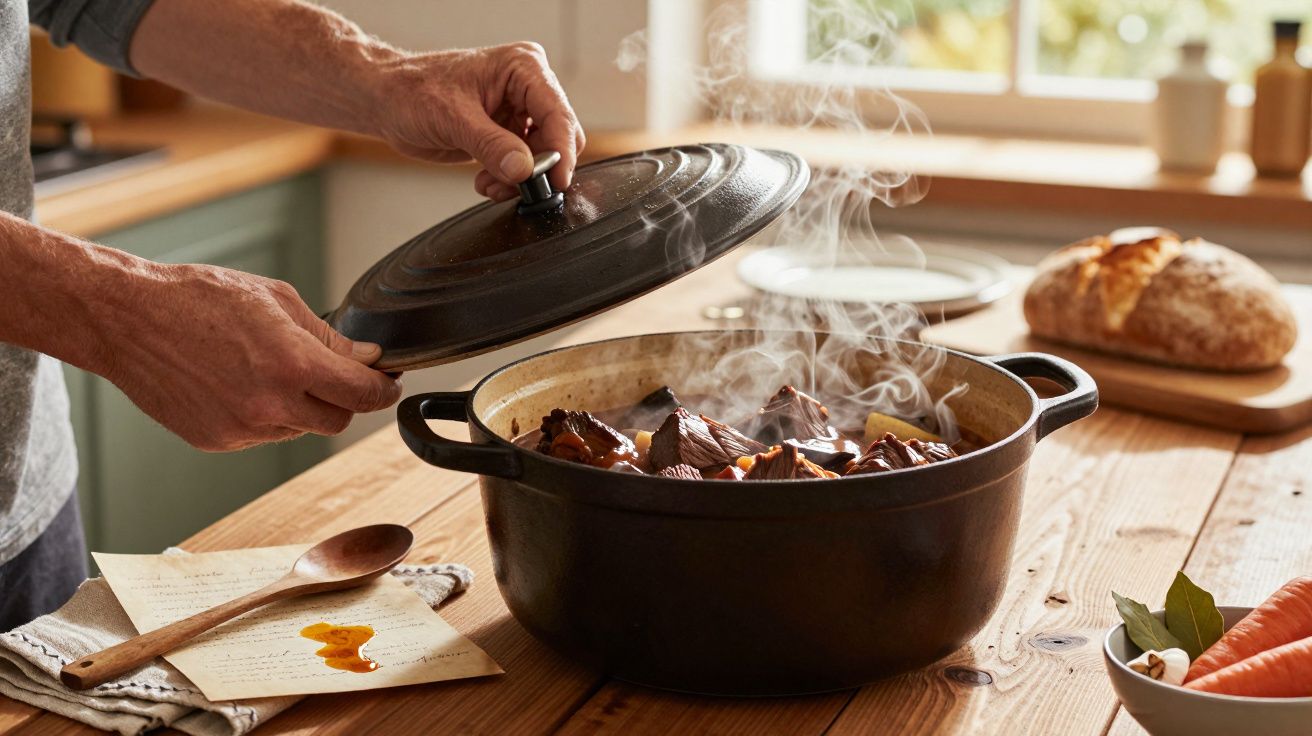
On winter Sundays in my childhood home, the whole day smelled like beef and patience.
The windows fogged up, the dog patrolled under the table, and my mother kept lifting the lid of a heavy pot, releasing a cloud of steam that carried garlic, red wine, and something deeper I couldn’t name.
We were not a fancy family. The beef came from the cheaper section, the carrots were always a bit crooked, and the onions made my dad tear up long before the stories did.
But by evening, that slow-cooked beef had turned into something we all leaned toward, elbows on the table, waiting for the first bite.
Years later, in my own small kitchen, I still cook that same dish almost the same way.
Almost.
A carne de vaca estufada lentamente que definiu os meus domingos
The dish itself is deceptively simple: tough cuts of beef, browned until they stick just a little, then left to collapse slowly in a bath of stock, wine, and vegetables.
Nothing about it screams “recipe of the year”.
Yet that pot on the stove was the center of our family’s gravity.
If you walked into our house on those days, the first thing you did was breathe a little deeper.
You could taste the afternoon just by standing near the kitchen door.
That’s how you know a dish has roots, not just flavor.
My mother never followed a written recipe.
She cooked from memory, from instinct, from that quiet calculation you see in home cooks who’ve fed too many hungry people to be precious about measurements.
She’d toss in a handful of chopped onions, a palmful of salt, exactly three bay leaves “because two is lazy and four is greedy”, as she liked to say.
The beef went in as clumsy cubes, hit the hot oil, and suddenly the whole room changed.
Later came the red wine, the sound of it hissing in the pan, scraping up the browned bits like they were secrets.
We’ve all been there, that moment when the smell alone tells you the day is going to be okay.
Looking back, I realize this slow-cooked beef dish was less about culinary genius and more about time.
Long, low heat does something to meat, yes, but it also does something to people.
Hours of gentle simmering forced us to stay put.
You couldn’t rush out the door when dinner needed another hour.
You couldn’t “just grab something quick” when the pot had already been on since noon.
That rhythm carved itself into me.
Food that asks for time usually gives it back to you in other forms: conversation, calm, the sense that for a few hours at least, the world can wait.
Como ainda a cozinho hoje (quase exatamente)
These days, when I cook that beef, I start the same way my mother did: I choose the “ugly” cuts.
Chuck, shoulder, sometimes even shank if that’s what’s on sale.
I cut the meat into big chunks, not polite cubes.
I dry them with a paper towel, then drop them into a heavy pot that’s already hot with a thin layer of oil.
The first sizzle is non-negotiable.
I let the beef go a little darker than feels safe, until the bottom of the pot is covered with browned, stubborn bits.
Then comes onion, carrot, garlic, and a splash of tomato paste, stirred until it clings to everything.
Only then do I add the red wine, just enough stock to half-cover the meat, and a small bouquet of thyme and bay leaves.
Over the years, I’ve learned where this dish forgives you and where it doesn’t.
You can swap red wine for beer.
You can trade carrots for parsnips.
You can forget the tomato paste one day and no one will revolt.
What you can’t do is rush the heat.
Turn it too high and the sauce tastes angry, the meat tightens instead of yielding.
Get impatient and start poking and stirring too much and you lose the quiet magic of letting things just be.
Let’s be honest: nobody really does this every single day.
Most nights we’re reheating leftovers, opening jars, or eating standing at the counter.
This dish lives in that rare space where you decide, consciously, that dinner will take as long as it needs.
There’s one detail I keep exactly as my mother did, and it’s small but stubborn: I always salt the meat in two steps.
A little at the start, a little halfway through the cooking.
It feels almost ceremonial now.
Around the second hour, when the beef is soft but not yet “fall apart”, I lift the lid, dip a spoon in, and taste.
That’s when I adjust the salt and pepper.
My mother used to say, “You don’t season the food, you season the moment,” and I laughed at the time.
Now I get it.
She was talking about paying attention.
- Brown the meat deeply before adding liquid
- Keep the liquid level low: half-cover the meat, not more
- Cook low and slow: a gentle simmer, not a rolling boil
- Taste and season again midway through cooking
- Let the dish rest 15–20 minutes off the heat before serving
O que este prato ainda me dá, anos depois
When I cook this slow-cooked beef now, I’m not just chasing a childhood flavor.
I’m choosing a tempo for the day.
The pot goes on, the flame drops low, and suddenly the whole afternoon stretches differently.
Laundry gets folded between stirs, emails are answered with less edge, someone wanders into the kitchen asking, “How long until it’s ready?” and stays to chop parsley.
I could modernize it.
Swap the pot for a pressure cooker, cut the time in half, track the recipe in a glossy app.
But I don’t.
Not for this one.
Some dishes work because they resist optimization.
What surprises me most is how this beef has become a kind of language with the people I love.
Friends know that if they smell it from the hallway, they’re allowed to stay for dinner.
Neighbors have learned that a plastic container might appear at their door the next day with leftovers still warm.
The recipe has slipped into other homes now.
Someone added mushrooms.
Someone else uses white wine and leeks.
A cousin throws in a square of dark chocolate at the end, swears it “rounds out the flavor”.
I nod, smile, and quietly keep doing it the way I was taught, plus my own tiny tweaks.
Tradition isn’t about freezing a dish in time.
It’s about letting it travel without losing its core.
Maybe you didn’t grow up with this exact slow-cooked beef.
Maybe your version was a lamb stew, a pot of beans, a chicken braise that perfumed the curtains for days.
The specifics matter less than the feeling: the slow certainty that something good is happening on the stove, even when life outside feels unsettled.
That’s what keeps me chopping onions on sleepy Sundays, that’s what keeps me fishing out bay leaves before serving, that’s what makes me smile when the pot lid rattles just a little.
If you have a dish like this, write it down, even if the measurements are “a bit of this” and “until it smells right”.
Share it, pass it on, let it absorb other kitchens and other lives.
Somewhere down the line, someone will be standing over their own stove, thinking, “I grew up eating this… and I still make it the same way today.”
| Ponto-chave | Detalhe | Valor para o leitor |
|---|---|---|
| Use cortes mais rijos e sele bem | Acém, pá, ou chambão, selados até ficarem escuros e com crosta | Transforma carne barata em pedaços tenros e cheios de sabor |
| Lume baixo, muito tempo | Levantar fervura suave durante várias horas, mexendo o mínimo possível | Cria textura a desfazer-se na boca e um molho rico |
| Temperar em camadas | Sal no início e novamente a meio da cozedura | Sabor equilibrado e desenvolvido, em vez de um final “plano” e salgado |
Perguntas frequentes (FAQ)
- Que corte de vaca funciona melhor para cozer lentamente?
Procure cortes mais rijos e com boa marmoreação, como acém, pá ou pá de vaca (tipo “blade”). São mais baratos, cheios de colagénio, e desfazem-se lindamente com calor baixo e prolongado.- Posso usar uma panela de cozedura lenta em vez de um tacho pesado?
Sim, mas sele primeiro a carne e os legumes numa frigideira e só depois transfira tudo para a panela de cozedura lenta. Se saltar esse passo, perde muita profundidade e carácter.- Como evito que a carne fique seca ou esfiapada?
Mantenha o lume baixo e constante, não deixe ferver em força, e dê-lhe tempo suficiente. A carne seca costuma significar lume demasiado alto ou tempo insuficiente, sobretudo com cortes mais magros.- Preciso mesmo de vinho para este tipo de prato?
Não obrigatoriamente. Pode substituir o vinho por mais caldo e um pequeno toque de vinagre ou uma colher de concentrado de tomate para dar vivacidade. O vinho acrescenta complexidade, mas o método importa mais.- Com quanta antecedência posso cozinhar a carne estufada lentamente?
Este prato muitas vezes sabe melhor no dia seguinte. Pode cozinhá-lo com 1–2 dias de antecedência, refrigerar e depois aquecer suavemente no fogão, retirando a gordura solidificada à superfície antes de aquecer.

Comentários
Ainda não há comentários. Seja o primeiro!
Deixar um comentário